

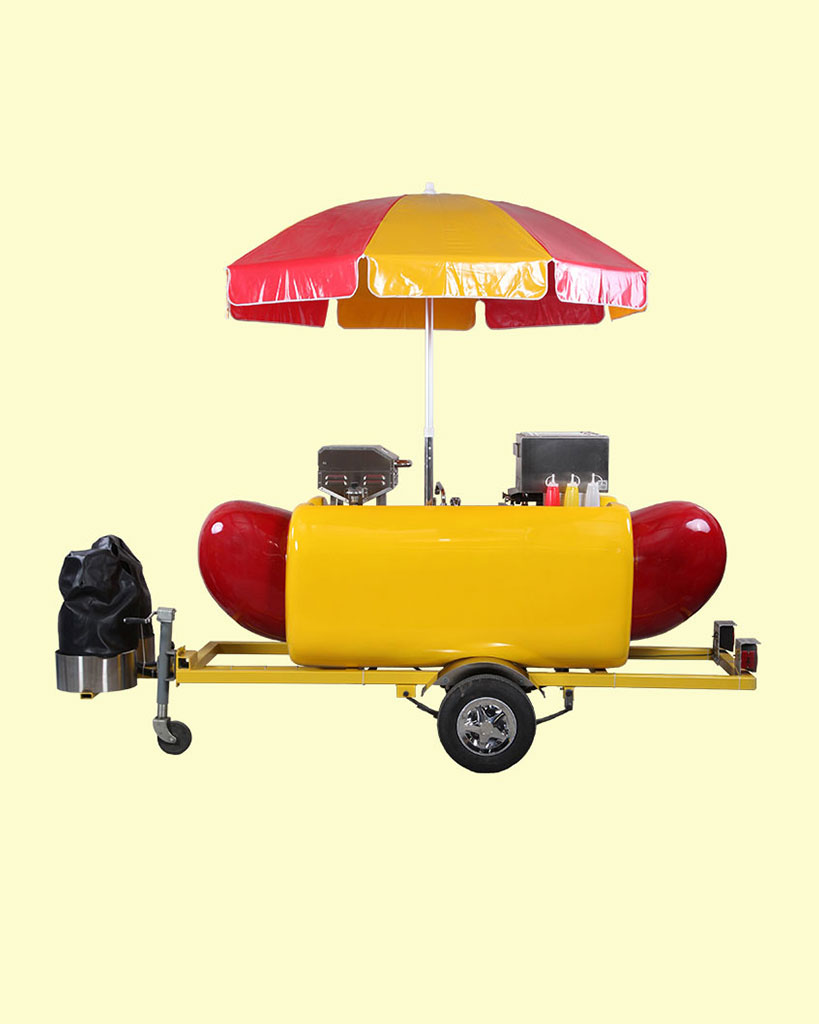
Canadian Hot Dog Cart
Business Manual
Starting your own hot dog cart concession business can be very rewarding and enjoyable as well as profitable. However, like any important endeavour, it should be done with some careful forethought and preparation.
This manual can also be used as a general guide for setting up just about any mobile food concession business including ice cream stands, pretzel stands, popcorn stands, and so on.
Download Your Free Business Guide
Getting Started
- Check Local Laws, Obtain Required Licenses and Permits.
- Check the Local County Health Codes, Obtain a Permit and Training.
- Find a Good Vending Location.
- Select a Suitable Vending Cart.
- Make the Necessary Financial Arrangements.
- Order Your Cart or Concession Trailer.
- Register Your New Business.
- Learn to Operate Your Food Concession Business.
Let’s look at these steps one at a time and go into them in detail.
Local Laws, Licenses and Permits
Check with your local municipality about a mobile food vending business license, usually available online or at city hall. Costs vary by city and business type and are different from restaurant licenses (often grouped with chip trucks or ice cream carts).
You must also review local by-laws governing hot dog or food carts, which may restrict where, when, and what you can sell, and require specific equipment (e.g., garbage bins, hand-washing sinks) while prohibiting others (e.g., seating). City staff can help clarify these rules.
If selling on streets, parks, or city property—or at events—you may need additional location permits, often at extra cost.
Once you understand the by-laws, permits, and fees, you’ll know if starting a food concession business in your area is feasible and can move to the next step.
Meeting the Health Codes
Food vending is heavily regulated for public safety, and rules vary by county or province. Your local health department sets the requirements for mobile food vending, and hot dog cart operators are considered professional food handlers.
Health departments regulate four main areas: food safety training, required equipment, allowed foods, and the health permit.
You may need to complete a short food safety course, covering hygiene, cleaning, cross-contamination, proper temperatures, and HACCP principles (managing food safety risks through time and temperature control).
They will also specify cart equipment requirements, such as sinks, water tanks, refrigeration, waste disposal, trash containers, and approved reheating equipment. It’s critical to know these requirements before buying a new or used cart, as upgrades can be costly.
Health codes limit what foods you can sell. Most carts may reheat pre-cooked wieners and sell packaged items and drinks. Preparing or storing raw meats is usually prohibited, and items like poultry, fish, or pork are often banned. Condiment rules also vary by area.
After meeting requirements and training, you can apply for a health permit, which may require cart plans and an inspection. Expect ongoing inspections, including surprise visits. Violations can lead to fines, permit revocation, and damage to your reputation. The permit must be displayed or kept on the cart.
You don’t need the permit yet, but you should understand the costs and requirements before moving forward.
Find a Good Vending Location
A good location is critical to the success of a food vending stand. It should be close to many hungry people, highly visible, easy to access, and have enough space for customers and safe operation.
The location must not block traffic or other businesses and should be easy to set up, restock, and operate daily. Many large businesses welcome food vendors to serve customers or employees—approach them directly and avoid paying rent unless required.
Public locations (streets, parks, parking lots) usually require a city permit and fee, but busy areas can be very profitable.
Potential locations include: retail stores, factories, business parks, downtown corners, transit stations, parks, parking lots, truck stops, car washes, airports, beaches, and amusement areas.
Temporary and seasonal venues—such as festivals, sporting events, concerts, fairs, and parades—can be highly profitable, sometimes matching a week’s sales in a single day.
You can also generate income through catering private events like parties and reunions.
Choosing the right location helps estimate daily sales and determines the type of cart you’ll need next.
A good location is critical to the success of a food vending stand. It should be close to many hungry people, highly visible, easy to access, and have enough space for customers and safe operation.
The location must not block traffic or other businesses and should be easy to set up, restock, and operate daily. Many large businesses welcome food vendors to serve customers or employees—approach them directly and avoid paying rent unless required.
Public locations (streets, parks, parking lots) usually require a city permit and fee, but busy areas can be very profitable.
Potential locations include: retail stores, factories, business parks, downtown corners, transit stations, parks, parking lots, truck stops, car washes, airports, beaches, and amusement areas.
Temporary and seasonal venues—such as festivals, sporting events, concerts, fairs, and parades—can be highly profitable, sometimes matching a week’s sales in a single day.
You can also generate income through catering private events like parties and reunions. Choosing the right location helps estimate daily sales and determines the type of cart you’ll need next.
Select a Suitable Vending Cart
You must choose a cart model that fits your location, volume, health code, and budget. Key factors include serving capacity per hour, daily storage needs, menu equipment, health department requirements (sinks, water tanks, refrigeration), and cost.
Smaller carts (like Starter or New Yorker) suit low-traffic locations and lower budgets. Larger carts (such as Hummer, A101, or Stand-In models) handle higher traffic, offer more storage and equipment options, and support future growth—but cost more. Many vendors start small and upgrade as their business grows.
Carts vary in flexibility and can be customized to meet local health codes by adjusting sinks, water tanks, cooking equipment, and refrigeration. Larger carts offer more customization and all-weather operation.
Choose the smallest cart that meets your needs and budget now, with room to grow later.
Making the Financial Arrangements
At this stage, you should estimate the total startup cost of a mobile food concession. Budget for the following:
Startup Costs
- Vending cart (including freight & taxes)
- Business license
- Location permit
- Location rent (if applicable)
- Accountant fees
- Health permit
- Food safety training
- Business insurance
- Initial food supplies (meat, buns, condiments, drinks)
- Vehicle towing setup
- Trailer storage (if applicable)
Operating & Equipment Costs
- Cell phone
- Garbage can
- Cleaning supplies
- Vending supplies (bags, napkins, cutlery, gloves)
- Cash float
- Uniforms (aprons)
- Advertising flyers
- Cart signage & menu display
Add ~20% contingency for unexpected costs.
Financing Options
- Bank loan
- Line of credit
- Equipment lease
- Credit card
- Personal loan (family or friends)
This cost estimate helps you create a business plan for financing and to confirm your idea is viable. If borrowing from friends or family, put all terms in writing (amount, interest, repayment, contingencies).
Once finances are in place, you’re ready to order your food vending cart.
Order Your Cart
This will not likely be the first time you have spoken to our customer service team. You will have likely already been in touch with us regarding pricing and health department requirements. At this stage, however, we should carefully review with you the health code requirements for your area and make sure the cart model you have selected will be able to meet these. We will review the cart specifications with you to ensure they meet your needs. We will confirm the price and give you a delivery date estimate. A 50% deposit is required to start your order, with the remaining 50% payable before shipping.
Once your cart is ordered, use the time in between ordering and taking delivery to finalize all the other steps outlined above including taking any required food service safety training.
Register Your Business
In Canada, you will need to register your business with the Federal and Provincial Governments and you will be assigned a Business Number (BN). There is no charge for this. This becomes your account number with the government. You will use this to remit the Goods and Services Tax (GST), the Provincial Sales Tax (PST) also called the Retail Sales tax (RST), or the Harmonized Sales Tax (HST) in provinces which combine the GST and PST.
The government requires that you decide what kind of business you will be registered as – sole proprietorship, a partnership or a corporation. As a small business owner you will likely register as sole proprietor or as a partnership. There are often tax advantages to setting yourself up as a partner with your spouse even if they have only a 10% share in the company. You may wish to consult an accountant at this stage and pay a couple hundred dollars for some good advice.
The Canadian government gives excellent on-line advice about starting your own business at Canada One.
The government also puts on some good seminars for small business owners from time to time. These are very instructive regarding taxes and business practices and they cost nothing. When you register your business, you are put on a mailing list and are advised when these seminars are conducted in your area.
Registering with the tax office means that you will be required to submit the taxes that you collect according to a schedule that they will assign you, either monthly, semi-annually, or annually. At the same time, however, you are able to claim back the taxes that you have paid on your supplies.
You will need to select a name for your business. This name can not include or use any registered trade marks or names that are subject to copyright. It should reflect well on your business. It will identify you to the government, to your customers and to your suppliers.
Operating Your Food Concession Business
You will need to familiarize yourself with what is involved in the day to day running of a mobile food service business. To help you with that we have prepared a Mobile Food Cart Operations Manual. Carefully read this easy to understand, plain language manual. It will show you what you will be doing in the course of a typical business day running a mobile food stand. It puts into plain language all those complicated food safety laws and shows you how to put them into practice on a food cart.